
Sitemap
A list of all the posts and pages found on the site. For you robots out there, there is an XML version available for digesting as well.
Pages
Posts
Future Blog Post
Published:
This post will show up by default. To disable scheduling of future posts, edit config.yml and set future: false.
Blog Post number 4
Published:
This is a sample blog post. Lorem ipsum I can’t remember the rest of lorem ipsum and don’t have an internet connection right now. Testing testing testing this blog post. Blog posts are cool.
Blog Post number 3
Published:
This is a sample blog post. Lorem ipsum I can’t remember the rest of lorem ipsum and don’t have an internet connection right now. Testing testing testing this blog post. Blog posts are cool.
Blog Post number 2
Published:
This is a sample blog post. Lorem ipsum I can’t remember the rest of lorem ipsum and don’t have an internet connection right now. Testing testing testing this blog post. Blog posts are cool.
Blog Post number 1
Published:
This is a sample blog post. Lorem ipsum I can’t remember the rest of lorem ipsum and don’t have an internet connection right now. Testing testing testing this blog post. Blog posts are cool.
portfolio
Controllable Clustering with LLM-driven Embeddings
Given the inherent subjectivity of similarity in text, fully unsupervised text clustering is unlikely to produce groupings that are relevant across a variety of use cases. Traditional techniques to guide clustering rely on costly, time-consuming human feedback and/or pre-existing labels. Leveraging recent advancements in LLMs and decoder-only embedding models, this project presents techniques to effectively control text embeddings with minimal human input: instruction prefixing and LLM preprocessing. We evaluate clustering performance for datasets with multiple independent ground-truth labels, or perspectives, and find that these techniques can be used to improve clustering for one perspective or use case, at the cost of a tradeoff in performance for another use case. 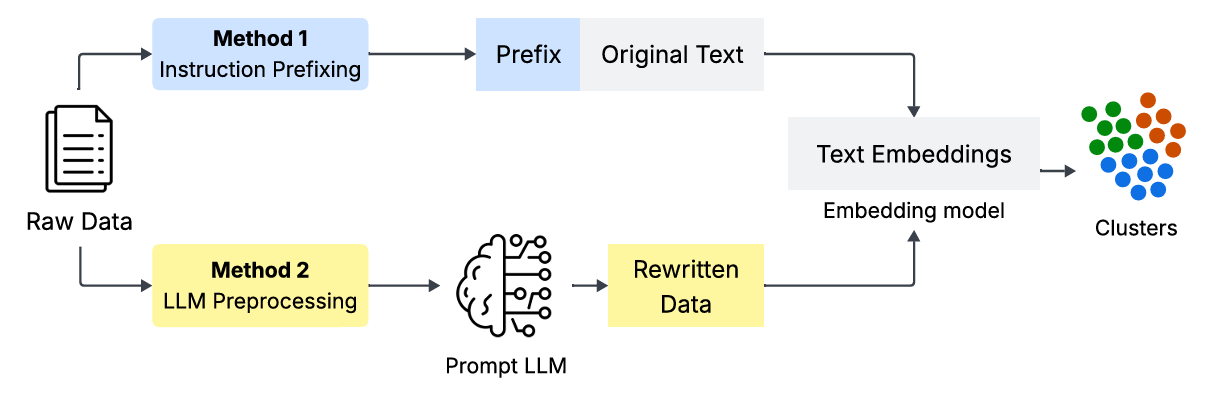
Inductive Orientation-enabled Model Characterization
As models grow more complex, interpretable black-box characterization techniques are increasingly relevant. Based on the algorithmic search framework, we present estimation methods for model-theoretic quantities, such as algorithm flexibility, sensitivity to data, and ability to specialize. We compute these quantities across a wide variety of classification algorithms, observing trends matching known heuristics and theoretical properties. We further utilize these metrics to compare algorithms of different architectures and hyperparameter configurations. These findings validate uses for model evaluation, comparison, and hyperparameter tuning.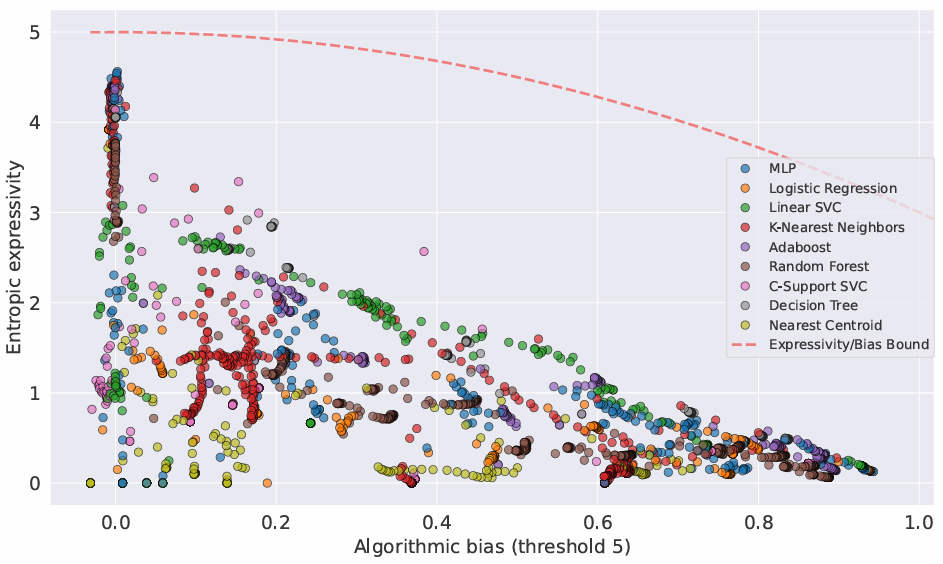
Probabilistic Error Guarantees for Abductive Inference
Abductive reasoning is ubiquitous in artificial intelligence and everyday thinking; however, formal theories that provide probabilistic guarantees for abductive inference are lacking. I led the development of a general framework for selective abduction based on Bayesian Decision Theory. With this framework, I have derived probabilistic bounds for abductive success in two ways: (1) rewarding the selection of one most likely cause, or (2) rewarding the selection of any cause whose probability is above some threshold. The former relies purely on Bayesian probability, whereas the latter combines it with a search approach through past developments with the Algorithmic Search Framework (ASF). By incorporating uncertainty in background knowledge, this work establishes probabilistic bounds on the success of selective abduction, leverages information-theoretic results from the ASF, and provides mathematical justifications for everyday abductive intuitions. 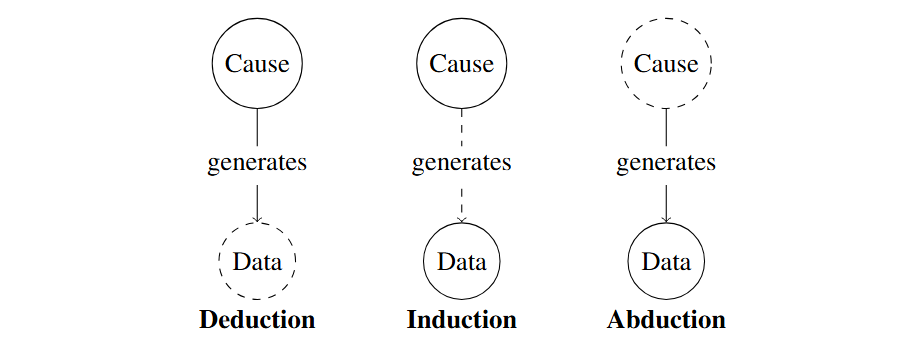
Bounded-confidence Cascade Parameter Fitting
Bounded-confidence cascades simulate the spread of ideas on a social network. Fitting these models with social media datasets would let us study the mechanics of online political polarization. However, bounded-confidence model fitting is largely unexplored by the field due to incompatibility between messy, real datasets and the model’s abstract foundations. 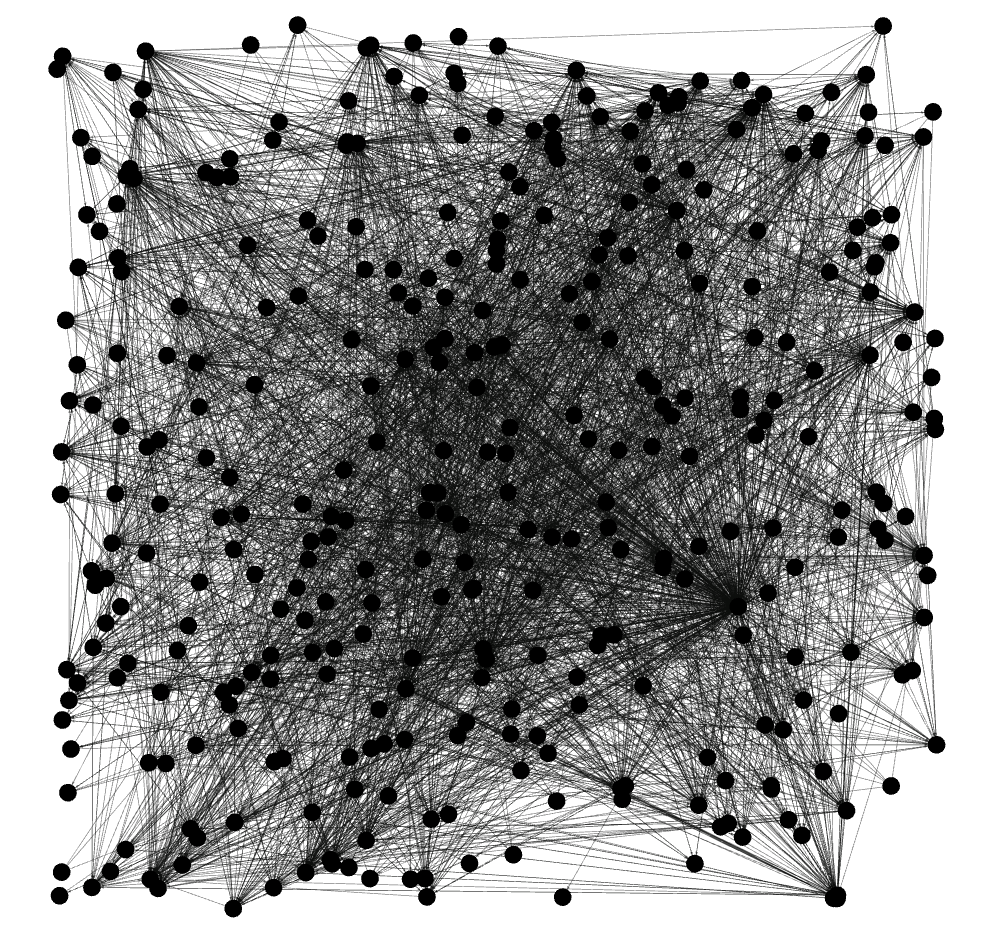
publications
Paper Title Number 1
Published in Journal 1, 2009
This paper is about the number 1. The number 2 is left for future work.
Recommended citation: Your Name, You. (2009). "Paper Title Number 1." Journal 1. 1(1).
Download Paper | Download Slides | Download Bibtex
Paper Title Number 2
Published in Journal 1, 2010
This paper is about the number 2. The number 3 is left for future work.
Recommended citation: Your Name, You. (2010). "Paper Title Number 2." Journal 1. 1(2).
Download Paper | Download Slides
Paper Title Number 3
Published in Journal 1, 2015
This paper is about the number 3. The number 4 is left for future work.
Recommended citation: Your Name, You. (2015). "Paper Title Number 3." Journal 1. 1(3).
Download Paper | Download Slides
Paper Title Number 4
Published in GitHub Journal of Bugs, 2024
This paper is about fixing template issue #693.
Recommended citation: Your Name, You. (2024). "Paper Title Number 3." GitHub Journal of Bugs. 1(3).
Download Paper
Paper Title Number 5, with math \(E=mc^2\)
Published in GitHub Journal of Bugs, 2024
This paper is about a famous math equation, \(E=mc^2\)
Recommended citation: Your Name, You. (2024). "Paper Title Number 3." GitHub Journal of Bugs. 1(3).
Download Paper
Portfolio item number 2
Published in , 1900
Short description of portfolio item number 2 
talks
Talk 1 on Relevant Topic in Your Field
Published:
This is a description of your talk, which is a markdown file that can be all markdown-ified like any other post. Yay markdown!
Conference Proceeding talk 3 on Relevant Topic in Your Field
Published:
This is a description of your conference proceedings talk, note the different field in type. You can put anything in this field.
teaching
Teaching experience 1
Undergraduate course, University 1, Department, 2014
This is a description of a teaching experience. You can use markdown like any other post.
Teaching experience 2
Workshop, University 1, Department, 2015
This is a description of a teaching experience. You can use markdown like any other post.